This article is a follow-up to,“How AI Is Reshaping the Workplace: Perspectives from the Front Lines,” which explored the impact of artificial intelligence across industries such as healthcare, journalism, and education. This update focuses on how Illinois is addressing the challenges and opportunities of integrating AI into K-12 public schools.
From Industry to the Classroom
Artificial intelligence has moved from a productivity tool in offices and newsrooms to a growing concern in school districts across the country. As generative AI tools gain popularity among students and educators, Illinois is among the states actively developing infrastructure, training, and legislation to guide its use in education.
State Lawmakers Introduce Bills to Regulate AI in Schools
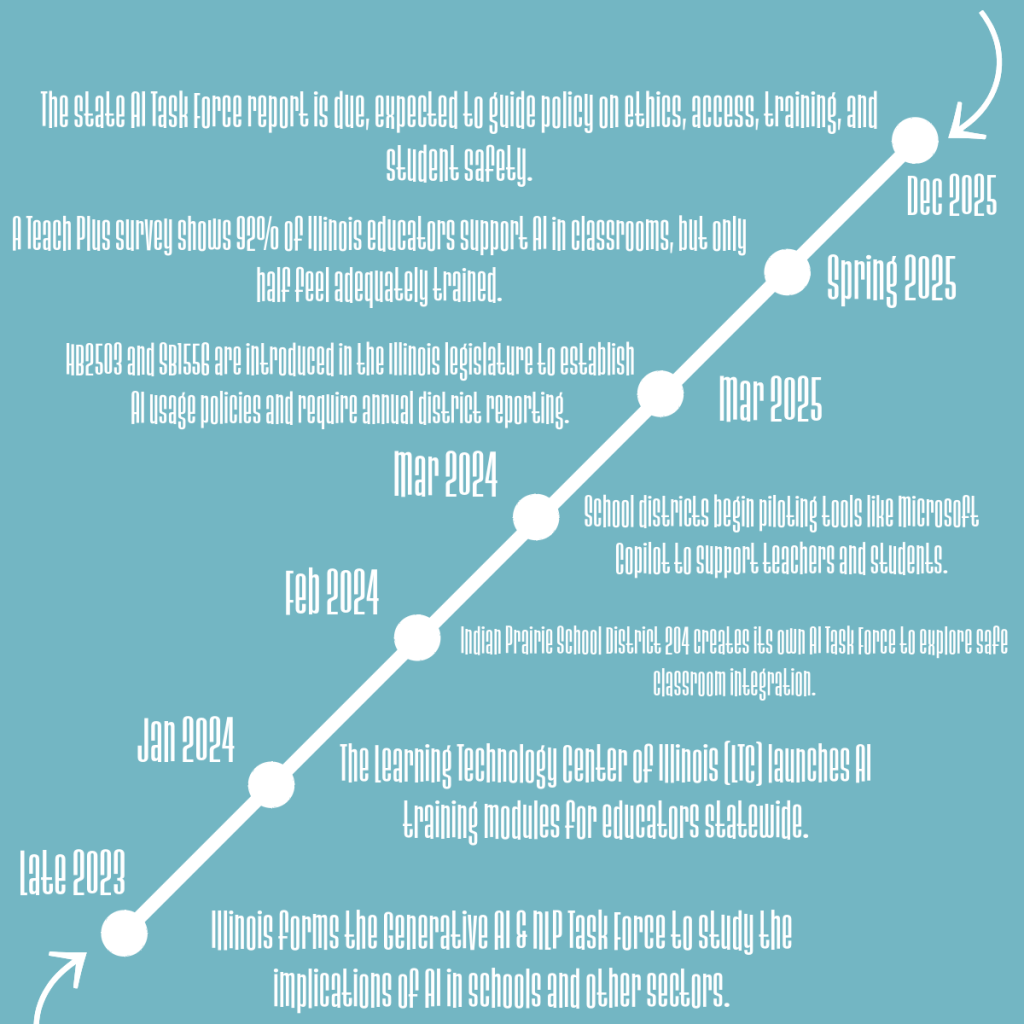
In March 2025, Illinois lawmakers introduced House Bill 2503 and Senate Bill 1556. The proposals aim to regulate how AI is used in classrooms across the state.
House Bill 2503, led by Rep. Laura Faver Dias, would create an AI advisory council and require school districts to report annually on how students, teachers, and administrators are using AI. The bill would also update the state-mandated internet safety curriculum to include training on AI-generated misinformation.
“We need to equip them to be able to have those conversations and teach students how to use it responsibly and ethically,” Dias told Chalkbeat Chicago.
Both bills highlight growing concerns among legislators that AI is no longer just a tech issue. It’s now an education policy issue as well.
Teachers Seek Guidance Amid Rising AI Adoption
While lawmakers work on regulation, educators across the state are calling for more structured support. A policy brief released by Teach Plus in March 2025 found that 92 percent of Illinois teachers surveyed believe AI has potential in the classroom. However, only 53 percent said they had received adequate training on how to use it effectively or responsibly.
“Teachers need support and resources so they can ensure AI supports equity in their classrooms, not replaces them,” said Jon Bassett, Illinois policy manager for Teach Plus.
Some educators are already experimenting with AI tools. Joe Brewer, a Teach Plus fellow and rural high school teacher, said he has used AI to help students engage with classic literature by tailoring material to their interests. He supports responsible use but warned that uneven access to technology could widen existing equity gaps.
School Districts Begin Their AI Initiatives
At the district level, Indian Prairie School District 204 has launched a dedicated AI task force. The group is evaluating the use of Microsoft Copilot and other tools to determine how AI can enhance instruction across grade levels.
“The aim is to prepare students for a future that will almost certainly involve collaboration with AI tools in college, careers, and daily life,” said Dr. Cathy Pezanoski, assistant superintendent for instructional services.
Other districts are monitoring the initiative while waiting for clearer state guidance before committing to similar efforts.
State Task Force Expected to Deliver AI Recommendations
In late 2023, Illinois formed the Generative AI and Natural Language Processing Task Force. The committee, composed of educators, policymakers, and technology experts, was charged with evaluating AI’s impact in various sectors, including education.
As of March 2025, the task force has not yet published its final report. The recommendations, due Dec. 31, 2024, are expected to address issues such as:
- AI literacy and curriculum development
- Student data privacy and cybersecurity
- Professional development for teachers
- Mitigating algorithmic bias in education tools
In anticipation of the task force’s findings, the Learning Technology Center of Illinois has launched workshops and training modules to help educators prepare for AI integration.
Illinois as a National Model?
Illinois is not alone in its attempt to understand the role of AI in education, but it is among the most proactive. The combination of grassroots educator involvement, pilot programs at the district level, and pending state legislation places Illinois in a unique position to lead by example.
As noted in my original Capstone research, successful AI adoption in the workplace, and now the classroom requires more than access to technology. It depends on clear policy, equitable training, and a shared cultural understanding of how to use AI as a tool for empowerment, not replacement.
If Illinois succeeds in implementing these strategies, it could offer a roadmap for other states seeking to integrate AI in schools responsibly.
Sources
- Chalkbeat Chicago. (2025). Illinois lawmakers want schools to track AI use and update internet safety curriculum. https://www.chalkbeat.org/chicago/2025/03/17/illinois-lawmakers-considers-proposal-to-put-guardrails-on-ai/
- Teach Plus. (2025). AI Integration in Illinois Classrooms: Educator Perspectives and Policy Recommendations. https://www.myjournalcourier.com/news/article/teach-plus-calls-illinois-government-ai-policy-20136318.php
- Brewer, J. (2025). Responsible AI integration in rural schools. https://www.myjournalcourier.com/opinion/article/responsible-ai-integration-schools-joe-brewer-20152395.php
- GovTech. (2025). Illinois District to Incorporate AI Tools Across Grade Levels.
https://www.govtech.com/education/k-12/illinois-district-incorporating-ai-into-all-grade-levels - LTC Illinois. (2024). Anticipating AI in Illinois Classrooms: Resources & Roadmap.
https://www.ltcillinois.org/anticipating-il-ai/
 Tech Releases
Leave a comment